Walk Mead Street on a September afternoon and the eye reads it as one long stretch of green, broken only by a stone chapel and a scatter of old farmhouses. Goldenrod leans into the road past the country club gates. A meadow trail disappears into taller grass just past a small wooden bridge. Farther down, a wider field opens out where the road bends toward the old Mead Homestead. It looks like a single, unbroken piece of preserved land, the kind of thing a town just decides to protect and then leaves alone.
It is not one piece of anything. That mile of road in Waccabuc holds three separately managed nature preserves, a National Register historic district, and a working country club, and no single organization is responsible for all of it. Long Pond Preserve answers to the Three Lakes Council. Pine Croft Meadow Preserve answers to Westchester Land Trust. Old Field Preserve answers to the Town of Lewisboro and Westchester County jointly. The chapel and cemetery answer to a family trust that has run them since 1907. Four different calendars, four different maintenance philosophies, all visible from the same short walk.
Why the meadow looks unfinished on purpose
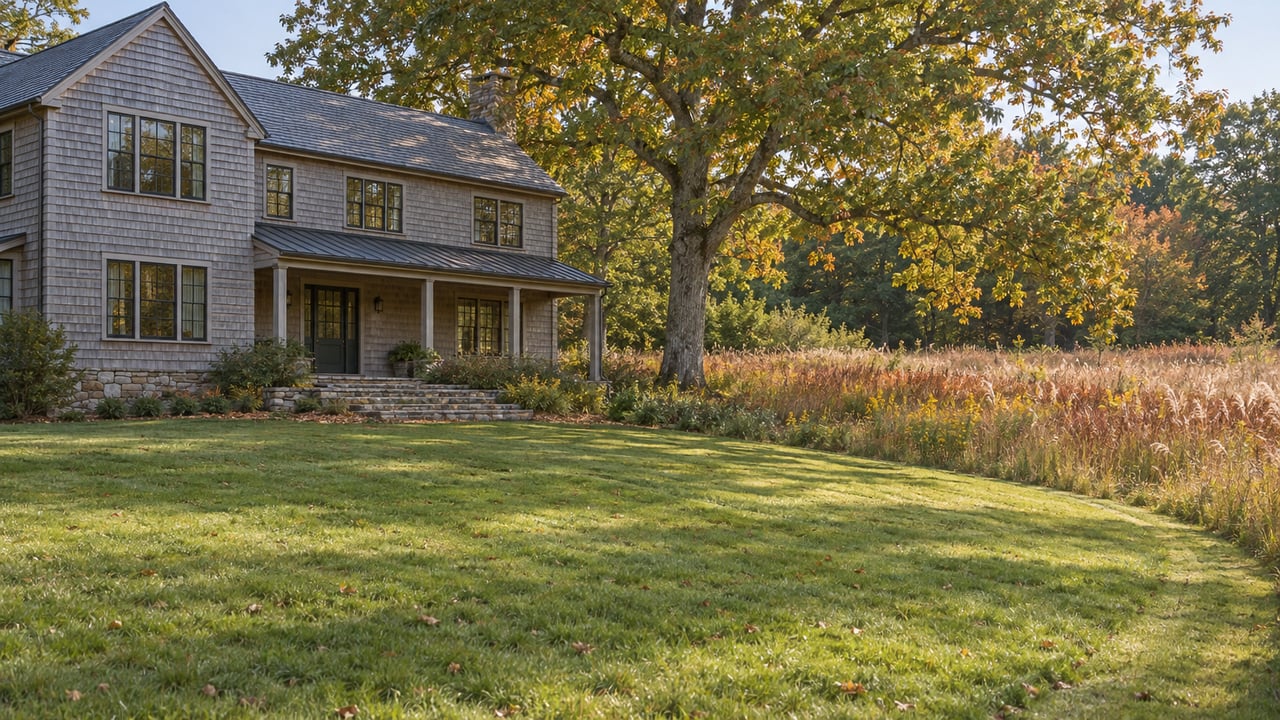
The clearest example is Pine Croft Meadow Preserve, a nine-acre parcel just past the country club on Route 35. A visitor expecting a manicured park will find something closer to an overgrown field, thick with native grasses, rushes, and sedges that seem to have gone untouched for months. That is exactly the plan. Westchester Land Trust mows the meadow only once a year, in November, specifically to let the vegetation stand through the growing season so pollinators can use it.
That single mowing decision is doing real ecological work. The preserve supports one of the region's last remaining colonies of the Baltimore Checkerspot butterfly, a species in steep decline across Westchester. Its host plant, white turtlehead, gets grazed hard by deer and crowded out by invasive species, so the land trust has been working to reestablish stands of it in the preserve's wetter pockets. Late summer and early fall are when the meadow does the most visible work of its year: goldenrod in bloom, monarchs and tiger swallowtails moving through, and the Checkerspot colony hanging on in a corner of Westchester where the habitat it needs has mostly disappeared.
None of that is apparent from the road unless you know to look for it. A neighbor who assumes the meadow needs cutting is looking at a management choice, not neglect.
The same walk, three different rulebooks
A few hundred feet away, Long Pond Preserve runs a different kind of calendar. The 39-acre parcel was acquired from the Mead family and Waccabuc residents in 1970, originally under the Nature Conservancy, before management passed to the Three Lakes Council of Lewisboro in 2015. Its short trail begins off Mead Street directly across from the historic chapel and leads down through forest to a wet meadow overlooking the western end of Lake Waccabuc. It is a lollipop loop, easy enough for most walkers, and it exists because Mead descendants and their neighbors chose in the 1970s to buy the land themselves rather than let it be developed.
Farther down the road, Old Field Preserve is a different scale entirely. At 110 acres it is the largest of the three, and its history runs through actual agriculture rather than conservation philanthropy. The land was originally part of the 86,000-acre Van Cortlandt Manor tract, settled in 1776 by Enoch Mead, and farmed continuously by his descendants until 1974. For nearly thirty years after that it sat in informal use, enjoyed by riders, walkers, cross-country skiers, and hunters without any formal protection. The Town of Lewisboro, Westchester County, and New York State did not complete the purchase until 2003, with meaningful help from local residents who wanted to see it protected rather than sold.
Three preserves within easy walking distance of one another, and three completely different reasons they exist: a 1970s land-preservation deal among neighbors, a 2003 three-way government purchase, and an ongoing land trust project built around a single endangered butterfly.
A quarter mile of Mead history
The buildings threaded along the same stretch of road tell a more continuous story, because they belong to one family across nine generations. Enoch Mead and his wife Jemima settled near what was then called Long Pond in 1776, after a horse went lame on their wedding trip and they decided to stop rather than continue on to Massachusetts. Their descendants built the Mead Homestead around 1820, farmed the surrounding land for four generations, and eventually gave Mead Street its name because eight family households once lined it.
The Mead Memorial Chapel sits at the center of that legacy. Sarah Frances Studwell Mead commissioned it in 1905 as a memorial to her husband, George Washington Mead, and it was completed in 1907 in a late Gothic Revival style designed by Hobart B. Upjohn, grandson of the noted ecclesiastical architect Richard Upjohn. The chapel remains privately owned by the family, one of the few in the county still held that way, and it is still active for Sunday services along with an annual Christmas Eve service with a children's choir. Just down the road, the Mead Cemetery holds the family's oldest headstone, dated 1794, for Sally Mead, who died at fourteen.
Even the country club fits into this same short history. What is now Waccabuc Country Club opened in 1912 as the Lake Waccabuc Inn, built on what had been the Hoe Estate, and operated as a public inn until 1927 before converting to member-only use.
One historic district, four different landlords
In 2015, the entire stretch, the houses, the chapel, the cemetery, the post office, and the preserves, was placed on the National Register of Historic Places as the Waccabuc Historic District. That designation treats the mile as a single, coherent place worth protecting. On paper, it is one entry in a federal registry.
On the ground, it takes four separate organizations working on four separate timelines to keep it looking the way it does. A land trust mowing a meadow once a year for a butterfly. A regional council managing a pond-adjacent woodland it helped save from development in the 1970s. A town and county running a 110-acre former farm they didn't finish buying until 2003. A single family maintaining a chapel and cemetery that predate all of that public involvement by more than a century. The federal listing recognizes the result. It says nothing about who's actually responsible for keeping it that way, and that fragmentation is worth knowing if you're the one walking past it every week.
What's worth seeing on Mead Street this fall
Right now, the meadow at Pine Croft is at its most alive, with goldenrod in bloom and the Baltimore Checkerspot colony still active before the land trust's scheduled November mow resets the cycle for next year. The Old Field Preserve trail, connecting through to Ward Pound Ridge Reservation, is wide open for the kind of longer fall walk that a nine-acre meadow can't offer. The chapel holds regular Sunday services for anyone curious about a building that has stood on that same corner since before most of the surrounding preserves existed in any form.
It is a short road to cover so much ground, historically and ecologically. Most of what makes it work happens quietly, on schedules set by people who will never meet each other, and none of it would be visible without knowing where to look.
If you've walked Mead Street and noticed something worth a second look, or you have a favorite corner of Waccabuc you think belongs in a future HOUSEwalks post, I'd like to hear about it. Reach out to Kathleen Usherwood and Let's Connect.